Announcement of the Winners

Talents contemporains 13e édition

Last February, four expert committees selected the works and projects of 32 finalists from among 621 applicants representing 75 countries.

The 2023 Grand Jury, chaired by Jean-Noël Jeanneney, was composed of:

  • Rosa-Maria Malet – Director of the Miró Foundation (1980–2017) and Board Member (Barcelona)
  • Constance de Monbrison – Head of the Insulindia Collections at the Musée du Quai Branly – Jacques Chirac (Paris)
  • Alfred Pacquement – Honorary General Curator of Heritage (Paris)
  • Roland Wetzel – Director of the Tinguely Museum (Basel)

The award-winning artists for this 13th edition are Pascale Ettlin, Vardit Goldner, Elise Grenois, Maryam Khosrovani, Yosra Mojtahedi, Aurélie Scouarnec, and Suhail Shaikh.

Pascale Ettlin presents Perdre Pied (Losing One’s Footing), a fascinating diptych composed of shades of blue and yellow; Vardit Goldner offers Swimming Lesson, a politically engaged video work; Elise Grenois intrigues and questions the viewer with her crystallized animals in Untitled; in Sève (Sap), Maryam Khosrovani speaks to us of exile and Iranian culture; Yosra Mojtahedi presents Lilith, a sculptural and sound installation; Aurélie Scouarnec powerfully chronicles her experience in a shelter through a photographic series; and finally, Suhail Shaikh explores the tension between water and paper through his installation La délicate légèreté de l’être (The Delicate Lightness of Being).

We extend our warmest congratulations to the artists and look forward to welcoming their works into the collection in the near future.
Download the press release

Les lauréats

Pascale Ettlin

Born in 1968 in Geneva (Switzerland) | Lives and works near Lucerne (Switzerland)

After studying geography and political science at the University of Geneva, she trained as an artist at the Lucerne School of Art. Since 2012, Pascale Ettlin has devoted herself fully to her artistic practice, exploring the contradictions of our wonderful yet frightening world. She is often inspired by idyllic nature, adding strange elements. Her preferred medium is painting, but photography and printing also accompany her. Her work has been exhibited in Switzerland and Japan. In 2023, she was awarded an artist residency in Nagasaki (Japan).

Learn more

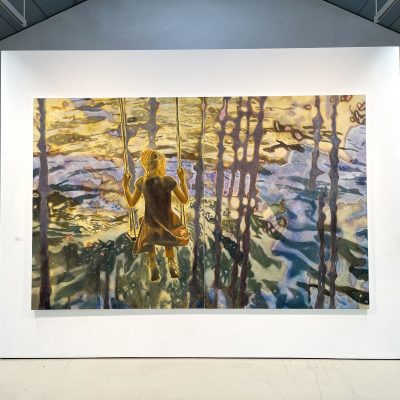
Perdre Pied, 2023. Dyptique, oils on canvas, 210 x 170 x 4,5 cm et 210 × 160 x 4,5 cm

Are we losing our footing? Are we losing the balance that keeps

the world in harmony? This is the philosophical question posed by

Pascale Ettlin in this poetic painting in cinematic format. In this diptych, a little girl, seen from the back, sways and seems to contemplate from above a landscape punctuated by yellows and blues, made up of interpenetrating land and water. At first glance, the artist seems to have thematized the innocence of childhood and the allure of sunny nature. However, as the waters cover the land, a muted unease gradually invades this idyllic world. What is the swing hanging on? How will the little girl be able to get down when it’s so high above the ground? Perdre Pied creates sensations of vertigo, of being trapped and powerless, echoing our unstable world and evoking our complex and contradictory relationship with the environment.

Vardit Goldner

Born in 1965 in Haifa (Israel) | Lives and works in Hod HaSharon (Israel)

Vardit Goldner is a specializing in photography and videography. Her artistic pursuits primarily focus on capturing the nuances of the Israeli-Palestinian conflict, shedding light on the everyday lives of Palestinians. She delves into social, environmental, and animal-related concerns through her work. She studied at the Faculty of Arts – Hamidrasha at Beit Berl College, (Israel), where she completed the Postgraduate Fine Arts Program, and she holds an M.Sc. in physics. Her work has been shown in festivals and exhibitions such as Earth Rising at IMMA, Dublin (2023).

Learn more

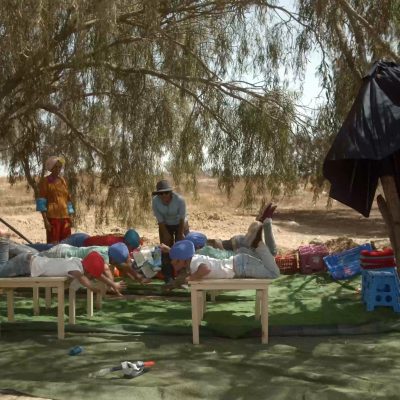
Swimming Lesson, 2021. Video, 5’

Swimming Lesson is an installation that shows a video and the set that was used to shoot that mockumentary video/film, in which Bedouin girls are taught to swim in a waterless “pool”. The work aims to stimulate thought about the lack of swimming pools accessible to Bedouins in Israel, actually denying them swimming lessons and causing frequent cases of drowning in the sea. This issue is part of a broader issue of discrimination and racism. The pool and the water are present in the work precisely because they were removed from it. The work also tackles the problem of the lack of swimming pools caused by discrimination. In the near future, there may be a shortage of water due to global warming, drought and water evaporation.

Elise Grenois

Born in 1992 in Nantes (France) | Lives and works in Strasbourg (France)

Graduated from HEAR in 2017 with a DNSEP Art Objet option glass, won the Prix de la Ville de Strasbourg and the Société des amis des arts et des musées de Strasbourg in 2017 and 2018. Her creations explore ephemeral materials and the transformation of objects over time. Using glass and kerosene, his pieces question the durability of objects. Some of his works are included in the collections of FRAC Franche-Comté (Espace Intermédiaire n°2, 2021) and FRAC Alsace (Espace Intermédiaire n°2 and n°3, 2021 and 2023).

Learn more

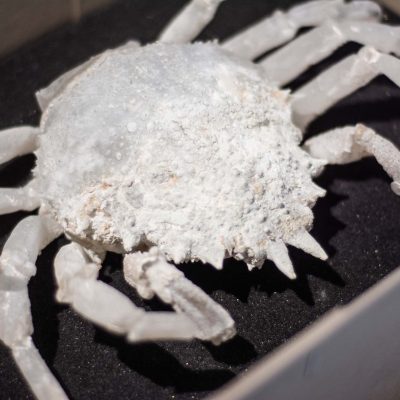
Sans titre, 2022. Metal, wood, cardboard, bone, ash, 89 x 90 x 43,5 cm

The crystallizations are the result of a technique akin to a cremation ritual. The process used by Elise Grenois has the ambivalence of destruction and preservation, as it allows putrefiable bodies to achieve a form of perpetuation. The crystallizations preserve the details of their bodies, the imprint of their scales and carapaces. The ashes and bones that once structured them can be seen frozen in the crystal. The artist’s intention is to preserve, to suspend time. For her, these fish, spider crabs and sea urchins are like anachronisms. Once living in a liquid environment, they have been transformed, becoming molten liquids in the process of cooking. Now cooled, they offer us a reading of their bodies, eternally frozen in crystal.


Maryam Khosrovani

Born in 1981 in Iran | Lives and works between Paris (France) and New York (United-States)

Maryam Khosrovani trained in graphic arts and art direction at ESAG Penninghen de l’Académie Julien in Paris (France), which she completed in 2011. She is developing a conceptual, multidisciplinary practice exploring the relationships between architecture, urbanism and natural ecosystems. Her work has been exhibited in galleries in New York, London and Los Angeles. Her work has been published by BBC News, Global Voices and The Guardian.

Learn more

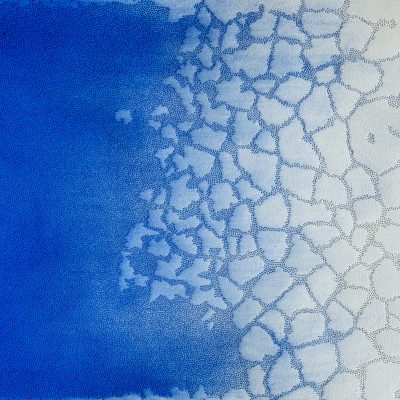
Sève, 2023. Variable techniques, 9 basins, 9 x (113 x 75 cm)

Maryam Khosrovani is an artist-architect as well as a weaver and archivist of motifs. Her serial installation of 9 basins, installed on the floor, is inspired by the central role of the fountain in traditional Iranian architecture. Each basin presents a different aquatic composition, using a different technique (embroidery on paper, coloured pencil, dyeing on paper, needlework, plaster moulding, etc.). The subtle gradations of blue and lapis lazuli (from deep blue to white) evoke the reflections of water (without water) on the motifs of a timeless architecture; the sites or visual ecosystems that populate the artist’s imagination. A process of memorial liquefaction, linked to the experience of exile, introduced by the title of the installation: Sève.

Yosra Mojtahedi

Born in 1986 in Teheran (Iran) | Lives and works in Lille (France)

A graduate of Le Fresnoy-Studio national des arts contemporains in 2020, Yosra Mojtahedi explores the intersection of art, science and technology, focusing on «soft robotics». Her sculptural installations, representing «machine-humans» or «body-fountains», unveil organic and mystical landscapes. Her work reveals a clear feminism, fusing nature and gender to transcend fragile boundaries. Winner of the ADAGP’s Prix Révélation d’art numérique et d’art vidéo in 2020, her work has been exhibited in prestigious venues such as the Musée de Soissons, La Villette, the Palais des Beaux-Arts in Brussels BOZAR, and Teatro del Canal in Madrid.

Learn more

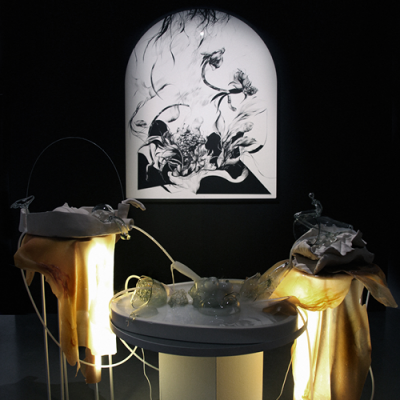
Lilith, 2023. Sculptural installation, ceramic, blown glass, latex, liquid, pipes, pumps, loudspeaker, drawings, variable dimensions

Lilith is a sculptural and sound installation in the form of a bodylandscape- self-generating fountain in which a white liquid flows, like milk or bodily fluids. It combines artifice, anatomy and sensuality to become a hybridization of the living. Bodies without bodies, mutant fossils, flayed or silicone skins, ebb and flow activate a living sculpture, even a mechanic of desire: the animate and the inanimate, the profane and the sacred interpenetrate in a sensual dance of flesh, materials, cables and liquids. Yosra Motjahedi’s work is based on the imaginary gushing and pleasure inspired by fountains. Her starting point is anatomy and dissection books, where the scopic impulse – to see and possess the other through the gaze – merges with the libidinal one. The result is a closed-circuit sculpture in which bodily fluids and mother’s milk seem to be in transit.

Aurélie Scouarnec

Born in 1990 in Argenteuil (France) | Lives and works in Paris (France)

Aurélie Scouarnec’s photographic work explores, through the deployment of sensory worlds, relationships on the edge of the invisible between profane and sacred, human and non-human. She was awarded the CNAP’s Soutien à la Photographie Documentaire Contemporaine in 2022, and the Bourse du Talent in 2021. Her work was the subject of a solo exhibition at the Galerie du Haut Pavé in Paris in 2023, and has been shown at the BnF, the Pavillon de l’Arsenal and other venues in France and abroad in recent years. She published her first book, Feræ, in 2023.

Learn more

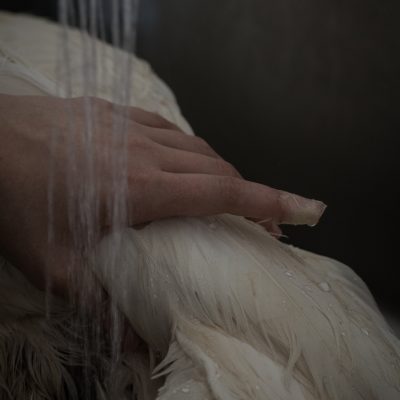
Feræ, 2021. Prints on Fine Art Rag Baryta paper, dark wenge frame, 7 x (40 x 60cm)

These seven images come from the Feræ project, which was carried out in wildlife care centers between 2020 and 2022. These images are a reminder of the essential role played by water in these places. It is what washes the shelters of wild animals every day, what rehydrates them, and sometimes even what helps to heal their wounds. It soaks the cloths that clean the surfaces every day, and fills the ponds set up for certain species. Water forms the aquatic environments on which wild animal species depend to varying degrees to live and feed. It also recalls us through the morphological particularities of certain animals that have adapted to it and arrive in these centers. The muted colors of these images play with revelation and concealment. Close to the textures, they approach the wounded bodies being cared for, opening up the space for a face-to-face encounter with animal otherness, where an attempt is made to repair our links with the living..

Suhail Shaikh

Born in 1969 in Bombay (India) | Lives and works in Lamastre (France)

Paper artist and industrial designer Suhail Shaikh transforms the simple sheet of paper into multidimensional works of art. His work reflects the ideas, thoughts and reactions that stem from his perception of the changing world around him. He has exhibited internationally in Belgium, Italy, Switzerland, Israel and the UK. In 2023, he will present his exhibition Papermywishes at the Atkinson Museum in Southport, England. His work is also part of several private collections in museums and public spaces.

Learn more

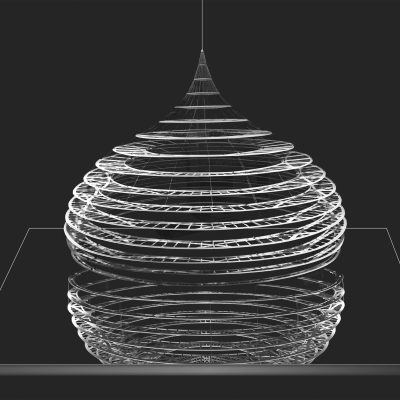
La délicate légèreté de l’être, 2017. Paper, water, variable dimensions

La délicate légèreté de l’être, is a meditative work using the visual interaction between paper and water, brought together in a sense of balance and wholeness. Despite their natural antagonism, paper and water here come together in a visual union, highlighting their constructive and destructive duality. A giant hemisphere, made of paper and formed of several concentric rings representing the ripples of water and spirituality, takes center stage. Reality and illusion come together to visually form the spherical shape of a drop of water. Suspended from a delicately balanced thread, this trembling drop, ready to fall, symbolizes what constitutes us and what we are… The artist highlights the interaction between paper and water, inviting us to explore the different facets of water in this mutual dialogue between the two elements. All of this is designed to awaken the visitor’s sensibility and enrich our perception of the world around us.